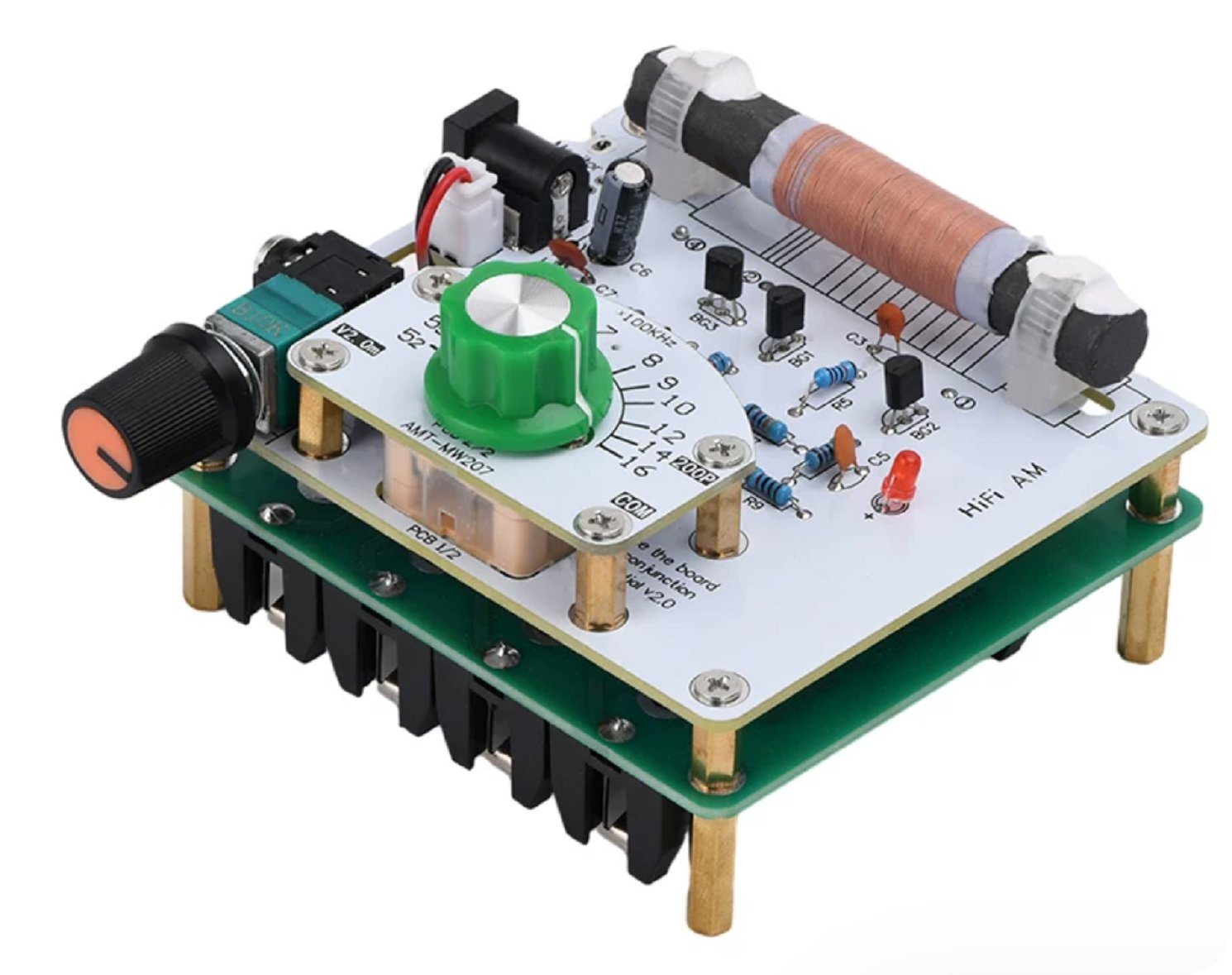
HS8509 MW AM AM Radio Transmitter 525~1605kHz 6V Radio Transmitter DIY Circuit Board Radio Motherboard
MW AM AM Radio Transmitter 525~1605kHz 6V Radio Transmitter DIY Circuit Board Radio Motherboard
Description:
1. The circuit is simple. Only commonly used transistors and resistive capacitive sensing components are used, without the need for an audio transformer, making it easy to manufacture;
2. Good sound quality. Within the rated transmission distance, the sound quality is close to FM radio, with good signal-to-noise ratio, especially when received by a repeater, the effect is not much different from directly playing modulated signals;
3. Without the need for an external antenna (medium wave requires tens of meters), the receiver is completely affected by the magnetic field leaked by the magnetic rod, which is easy to implement and has a relatively short transmission distance;
4. Multiple interfaces, designed with waveform testing terminals, audio sockets, external power sockets, etc., for easy use and expansion of functions;
5. It can be connected to an external power source and also installed with a battery for independent use.
Parameter:
Frequency range: 525~1605kHz
Supply voltage: 6V
DC power interface: 5.5 * 2.1mm
Circuit board size: 78mmx85mm (length x width)
Transmission distance: about 1 meter for superheterodyne medium wave radio, about 0.5 meters for direct and mineral radio
Package include:
1X module
1X3.5mm headphone signal cable
Product Introduction:
1. This kit adopts fully discrete circuit components, which is particularly suitable for students to learn working principles, practice production and testing;
2. Variable capacitors use dual variable capacitors, which are connected in parallel to obtain sufficient capacity;
3. Adopting double-sided board circuit, the board base is made of fiberglass material, with a measured thickness of about 1.5-1.6mm. The solder pads are treated with tin spraying and can be directly welded without polishing;
4. This product has undergone n modifications and improvements so far (mainly modifying the wiring of the circuit board and keeping the circuit unchanged), and is still being continuously improved. Usually minor non substantial modifications, such as slight movement of component positions or adjustments to wiring, will not change the version number, nor will they be re photographed and uploaded. This is hereby declared;
5. The manual contains circuit schematics and circuit board diagrams, as well as debugging methods and experience under amateur conditions. If more information and professional debugging methods are needed, buyers can download or refer to relevant professional books online; Mainly due to changes in component positions, the circuit structure remains unchanged.
6. The transmitter is equipped with a 3.5mm headphone signal cable, which does not include a battery.
Usage effect: This transmitter works very well within an effective distance (0.5~1 meter), with high sound fidelity. Especially when used with a direct broadcast radio (such as 636 and 68-1 single tube units) and high impedance dynamic coil headphones, the sound quality is not much different from that of a player playing directly.
Instructions:
1. Insert an external 6V DC power supply (positive inside and negative outside) into the CZ1 socket on the board, or plug the 6V battery pack connector into the Battery interface, being careful not to confuse the positive and negative poles.
2. Insert the signal cable into the CZ2 socket on the circuit board and connect it to the modulation signal source. The signal source can be a mobile phone, player, etc. It is recommended to use a player because mobile phones have strong interference with medium wave radios.
3. Turn the potentiometer knob to turn on the device, which has a similar effect to the volume potentiometer on a radio.
4. Turn on the radio and search for the signal from the transmitter to listen. You can also operate in reverse by adjusting the radio reception frequency to a position without a radio station, and then turning the transmitter dial to change the transmission frequency until the radio plays the signal from the transmitter.